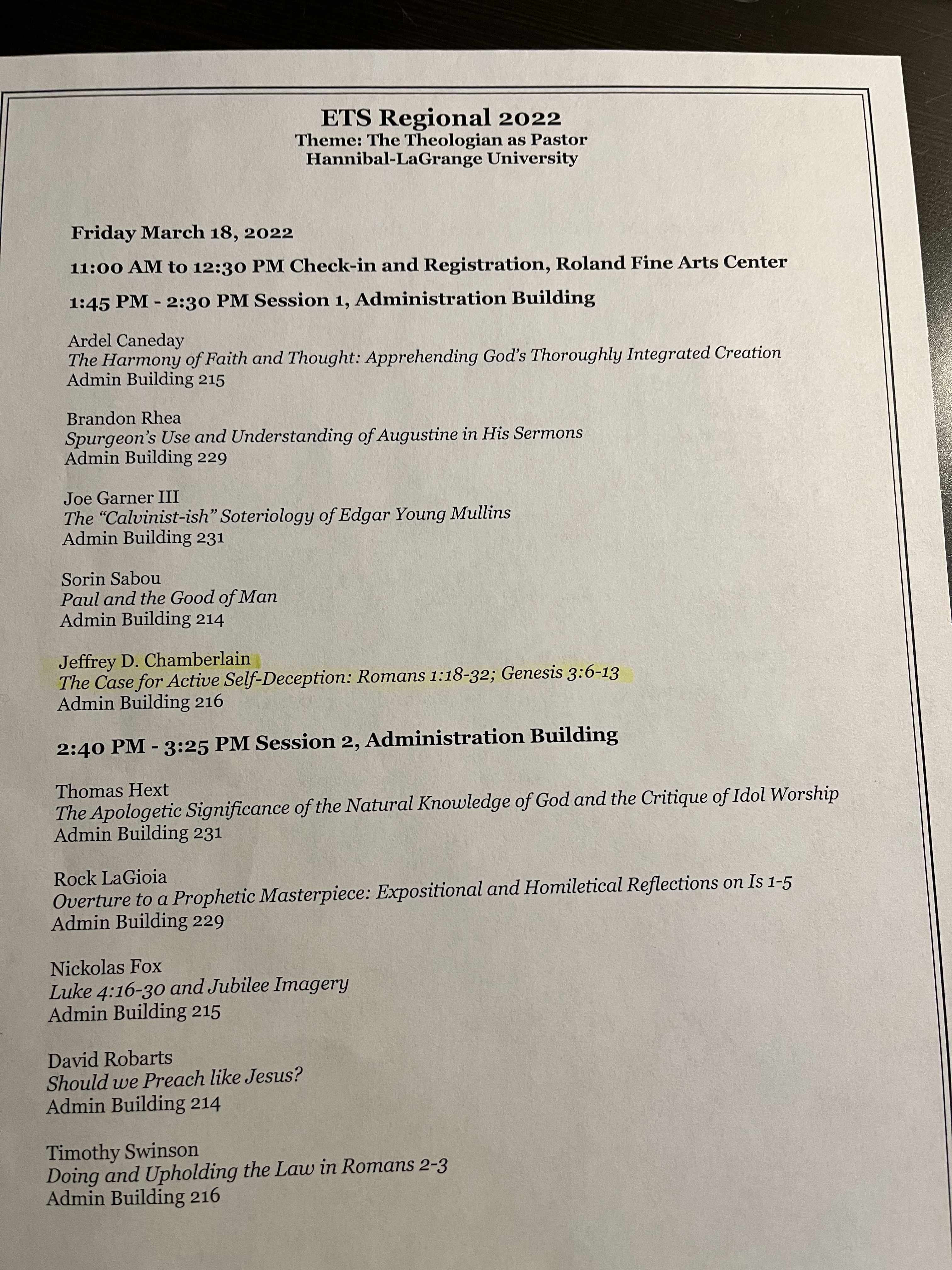
The Case for Active Self-Deception
Romans 1:18-32; Genesis 3:6-13
The condition of the unbeliever
If you have your Bible with you turn to Romans 1:18-32, if not follow along with me as I read. The text says, “18For the wrath of God is revealed from heaven against all ungodliness and unrighteousness of men, who by their unrighteousness suppress the truth. 19For what can be known about God is plain to them, because God has shown it to them. 20For his invisible attributes, namely, his eternal power and divine nature, have been clearly perceived, ever since the creation of the world, in the things that have been made. So they are without excuse. 21For although they knew God, they did not honor him as God or give thanks to him, but they became futile in their thinking, and their foolish hearts were darkened. 22Claiming to be wise, they became fools, 23and exchanged the glory of the immortal God for images resembling mortal man and birds and animals and creeping things.
24Therefore God gave them up in the lusts of their hearts to impurity, to the dishonoring of their bodies among themselves, 25because they exchanged the truth about God for a lie and worshiped and served the creature rather than the Creator, who is blessed forever! Amen.
26For this reason God gave them up to dishonorable passions. For their women exchanged natural relations for those that are contrary to nature; 27and the men likewise gave up natural relations with women and were consumed with passion for one another, men committing shameless acts with men and receiving in themselves the due penalty for their error.
28And since they did not see fit to acknowledge God, God gave them up to a debased mind to do what ought not to be done. 29They were filled with all manner of unrighteousness, evil, covetousness, malice. They are full of envy, murder, strife, deceit, maliciousness. They are gossips, 30slanderers, haters of God, insolent, haughty, boastful, inventors of evil, disobedient to parents, 31foolish, faithless, heartless, ruthless. 32Though they know God’s righteous decree that those who practice such things deserve to die, they not only do them but give approval to those who practice them.”
Even a cursory reading of this text reveals that the apostle Paul has unbelievers in mind as he writes this passage. It is interesting though that he is writing to the believers in Rome, as evidenced by what comes before this passage and what immediately follows in chapter 2, verse 1 where he gives the “therefore” for the text we just read. He states that “therefore you have no excuse, O man, every one of you who judges. For in passing judgment on another you condemn yourself, because you, the judge, practice the very same things.” It is also interesting when you
notice the pronouns in the passages preceding and following verses 18-32 verses the pronouns in verses 18-32. In the passage before, we see “I,” “we,” “you,” “yours,” and “mine,” and in the passages immediately following, we see “you” and “we.” The “we” especially signifies that Paul is including himself in the mix, so we can rightfully assume that the “you” is a designation of the believers in Rome. In verses 18-32, we see “their,” “them,” and “they” signifying the general condition of a group (unbelievers) separate from Paul and by extension separate from the believers in Rome. The point of bringing this up is to not only state the obvious fact that unbelievers act in the described ways and that they engage in active self-deception through their suppression of the truth and their exchanging the truth about God for a lie, but to demonstrate that the believer is often guilty of the same active self-deception as those who do not believe in God.
Examination of the active self-deception of unbelief
Before moving into an examination of what it looks for a believer to actively self-deceive themselves, it is necessary to further examine the concept of the active self-deception of unbelief. Os Guinness when looking for the biblical answer to the problem states that “the Bible’s answer takes us to the very heart of its diagnosis of unbelief, for in the biblical view the central core of the anatomy of unbelief stems from its willful abuse of truth. In our treatment of truth we, and all human beings, are at the same time both truth seekers and truth twisters, and in a deep mercurial, tenacious and fateful way.”[i] By way of agreement, Greg Bahnsen argues that “people do not merely play at self-deception; they engage in it in tragic ways.”[ii] Guinness further adds that “four prominent emphases recur most frequently, and together they form a multilayered view of the dark willfulness of sin, disobedience and unbelief.”[iii] Those four emphases are: “Unbelief abuses truth through a deliberate act of suppression, unbelief abuses truth through a deliberate act of exploitation, unbelief goes further still and abuses truth through a deliberate act of inversion, and unbelief abuses truth through a deliberate act of deception that ends in its own self-deception.”[iv] The concept of self-deception is difficult enough to wrap one’s mind around, but the idea of active and willful self-deception seems unbelievable.
If this concept of active self-deception is true, as the scriptures clearly state that it is, then it requires an honest assessment of what the true nature of human beings actually is. Why would a person intentionally deceive himself? Is it possible that he is unable to see or believe the truth as it really is? According to C. S. Lewis, “there is one vice in the world of which no man is free; which everyone in the world loathes when he sees it in someone else; and of which hardly any people, except Christians, ever imagine that they are guilty themselves…[and] there is no fault which makes man more unpopular, and no fault which we are more unconscious of in ourselves. And the more we have it ourselves, the more we dislike it in others. The vice I am talking of is Pride or Self-Conceit.”[v] He continues by making the claim that “Pride leads to every other vice: it is the complete anti-God state of mind.”[vi] Jonathan Haidt observes that “we lie, cheat, and justify so well that we honestly believe we are honest.”[vii] So what is the true nature of the unregenerate man? Soren Kierkegaard wrote, “But spiritually understood, man in his natural condition is sick, he is in error, in an illusion, and therefore desires most of all to be deceived, so that he may be permitted not only to remain in error but to find himself thoroughly comfortable in his self-deceit.”[viii] Kierkegaard draws much of that language from Jeremiah 17:9, which states that “the heart is deceitful above all things, and desperately sick; who can understand it?” In order to stress the point further, the apostle Paul adds that “the natural person does not accept the things of the Spirit of God, for they are folly to him, and he is not able to understand them because they are spiritually discerned” (1 Cor. 2:14) and he stresses the point even further regarding the human condition in Ephesians 2:1 and 5, “and you were dead in the trespasses and sins in which you once walked…[and] even when we were dead in our trespasses, [God] made us alive together with Christ.” So then, if unregenerate man’s true nature is dead in trespasses and sin and his heart is deceitful and desperately sick, how did he get that way? Now it is granted that the main focus of this paper is not the origins of sin or the fall of man, but it seems that both are quite necessary to rightfully know how and why humans are able to intentionally deceive themselves.
In order to proceed properly we need to look at the Fall in Genesis 3:1-13. I know that in the title of this paper it says verses 6-13, but it is necessary to start at verse 1 to provide the proper context.
1Now the serpent was more crafty than any other beast of the field that the LORD God had made.
He said to the woman, “Did God actually say, ‘You shall not eat of any tree in the garden’?” 2And the woman said to the serpent, “We may eat of the fruit of the trees in the garden, 3but God said, You shall not eat of the fruit of the tree that is in the midst of the garden, neither shall you touch it, lest you die.’” 4But the serpent said to the woman, “You will not surely die. 5For God knows that when you eat of it your eyes will be opened, and you will be like God, knowing good and evil.” 6So when the woman saw that the tree was good for food, and that it was a delight to the eyes, and that the tree was to be desired to make one wise, she took of its fruit and ate, and she also gave some to her husband who was with her, and he ate. 7Then the eyes of both were opened, and they knew that they were naked. And they sewed fig leaves together and made themselves loincloths.
8And they heard the sound of the LORD God walking in the garden in the cool of the day, and the man and his wife hid themselves from the presence of the LORD God among the trees of the garden. 9But the LORD God called to the man and said to him, “Where are you?” 10And he said, “I heard the sound of you in the garden, and I was afraid, because I was naked, and I hid myself.” 11He said, “Who told you that you were naked? Have you eaten of the tree of which I commanded you not to eat?” 12The man said, “The woman whom you gave to be with me, she gave me fruit of the tree, and I ate.” 13Then the LORD God said to the woman, “What is this that you have done?” The woman said, “The serpent deceived me, and I ate.”
It is interesting that when you contrast this passage with 1 John 2:16, you can see, “there [has always been] three elements necessary for sin – (1) the carnal “lust of the flesh”, (2) “the lust of the eye” (i.e. seeing an opportunity), but also (3) “the pride of life” to complete the snare. That is, when the voice of God says “no” to us, sin needs that proud inner statement “Why shouldn’t I have it?” or “I deserve it!” to be enacted. [It is utterly fascinating that] this appeal to pride is [still just as effective today as it was way back then in]… the Garden of Eden. When Satan there said “be like Gods” (Genesis 3.5), he knew it meant “be entrapped like a slave”.”[ix] The earlier quote from C. S. Lewis bears repeating that, “Pride leads to every other vice: it is the complete anti-God state of mind.” There is an often overlooked phrase that appears in Genesis 3:6, that is absolutely crucial to our topic today. Typically, this recounting of the Fall is presented in a way that makes the reader or hearer believe that Eve was alone when this encounter with the Serpent happened, but the text says, which I tried to emphasize when I read it, that “she also gave some to her husband who was with her, and he ate.” The dialogue is clearly between Eve and the Serpent, but Adam was right there present while this discussion was going on. What was he thinking? Adam was given the command not to eat of the tree of the knowledge of good and evil in chapter 2, verses 16 and 17 before God even created Eve, which raises the question of did Adam add to the command when he made the command known to Eve or did Eve add the aspect of not even touching it as is most often claimed? Either way, that aspect is not the point of examining the passage but it is definitely worth pondering. Why was Adam silent? Why did he eat of the fruit? Is it possible that Adam’s affections for his wife were greater than his affections for God? It seems like it is entirely possible and even likely that Adam’s affections for his wife was greater, which would make sense out of his decision to eat, which would indicate that Adam chose to deny what he knew to be true in order to do as he desired. According to Andre Geske in his article “Solidarity in the Fall: An Essay on Self-Deception, “Self-deception started when the first couple conceived reality according to their own interest, affection, and will. Man established himself as the criterion of truth, motivated by self-satisfaction.”[x] He continues later in the article by stating that, “the unregenerate, deceived through the obliteration of divine truth in their hearts, are guilty of deceiving themselves [referring back to] (Rom. 1:18). They fall in love with themselves like Narcissus, [of whom he examined earlier in the article]forming a religion that engages in the search for self-satisfaction.”[xi] Before moving on to examine self-deception in the life of the believer, some final comments are necessary on the dilemma that the unregenerate faces. One of the most common objections to the concept of Christianity being true is “what about the good person who has never heard of Jesus, or typically some form of that question is presented as a criticism of the exclusivity of Christ. The clear evidence of what has just been discussed as well as clear biblical evidence is that there is no such thing as a good man. All men are guilty of sin.
The truth of the Romans 1 passage bears repeating, verses 18-23 state, “18For the wrath of God is revealed from heaven against all ungodliness and unrighteousness of men, who by their unrighteousness suppress the truth. 19For what can be known about God is plain to them, because God has shown it to them. 20For his invisible attributes, namely, his eternal power and divine nature, have been clearly perceived, ever since the creation of the world, in the things that have been made. So they are without excuse. 21For although they knew God, they did not honor him as God or give thanks to him, but they became futile in their thinking, and their foolish hearts were darkened. 22Claiming to be wise, they became fools, 23and exchanged the glory of the immortal God for images resembling mortal man and birds and animals and creeping things.” In this passage, we see that men suppress the truth, which is an active verb, therefore, the result of that action is that they are without excuse. The Greek word translated as without excuse is “anapologetous,” so if we define apologetics as “giving a defense or reason for the faith, then without excuse would by extension mean that the consequence of actively suppressing the truth is that the person is without a defense or without a reason as to why they chose to rebel against the God that, as the text says, has been clearly perceived and they knew that God exists, therefore they are guilty. A question that I believe that has been answered in regards to the unregenerate but serves as a transition point to active self-deception in the regenerate. Is that what we are dealing with is not so much about “who does man think he is,” because that has been clearly shown, but rather, “how does he deal with who he really is,” which seems to shed more light on why man acts as he does.
Active Self-Deception in the Life of the Believer
So far the passages that we have examined have dealt with the unregenerate or the innocent and his fall into the situation that the unregenerate find themselves in. Quoting Geske again, he states that “because of the radical nature of self-deception both believer and non-believers can be self-deceived. In the Christian mind, self-deception works by relativizing Holy Scripture and changing the source of authority in life by theories and feelings. Sin acts surreptitiously, making good and evil or right and wrong interchangeable. Therefore, the Christian life must be lived in self-examination through the Holy Scriptures with an illumination of the Holy Spirit if the Christian is to form a worldview according to the principles of revelation.”[xii] There are three principles in the above quote that need to be fleshed out a little more, those are: the relativization of Scripture in order to shift authority, the often neglected, extremely important concept of self-examination in light of the truth of the Scriptures, and development of a biblical worldview. But before we proceed to the examination of those three principles, it is necessary to see if there are any biblical passages that state that a regenerate believer in Jesus Christ can be self-deceived. Galatians 6:3 states “3For if anyone thinks he is something, when he is nothing, he deceives himself.” 1 John 1:8 says that “8if we say we have no sin, we deceive ourselves, and the truth is not in us.” And 1 Corinthians 3:18-19, which states, “18Let no one deceive himself. If anyone among you thinks that he is wise in this age, let him become a fool that he may become wise. 19For the wisdom of this world is folly with God. For it is written, “He catches the wise in their craftiness,” 20and again, “The Lord knows the thoughts of the wise, that they are futile.” These are just a few but a simple web search will show that there 53 passages in the Bible that deal with this concept in one form or another.[xiii]
The relativization of Scripture in order to shift authority
We do not have to look far to see the commands of God being relativized in the Scripture. We have seen it in the Genesis 3 passage when the Serpent said, “Did God actually say?” in verse 1. And 2 Peter 3:15b-16 states “that just as our beloved brother Paul also wrote to you according to the wisdom given him, as he does in all his letters when he speaks in them of these matters. There are some things in them that are hard to understand, which the ignorant and unstable twist to their own destruction, as they do the other Scriptures.” Greg Koukl in Relativism: Feet Firmly Planted in Mid-Air claims that “relativism is much more extreme. In ethical subjectivism, everything is a private judgment call. All morality is personal; none is public. Every moral evaluation is a mere opinion, a personal preference. This is why relativists are so quick to say, “Don’t force your morality on me,” for no external code of conduct is legitimate in their view. Morality is private. The biblical description. Of this type of ethic is found in the Book of Judges where “Every man did what was right in his own eyes.”[xiv] Koukl’s book was first published in 1998, if it were re-written today, it would be intriguing to see how thick the book would end up being to cover all the craziness we see in today’s world and unfortunately in the church as well. In fact, the day that a re-worked book would be released is the day that the book would need to be re-worked because of the break-neck at which things are changing. The purpose of relativizing the Scripture is to attempt to wrestle away from the scriptures the authority that they carry, which is ultimately attempting to wrestle away the authority from God that is inherently his because of who he is, since it is his Word that is being relativized. A unfortunate and shameful example is a fairly recent sermon series by Andy Stanley in which he claims that “Jesus’ new covenant, His covenant with the nations, His covenant with you, His covenant with us, can stand on its own two nail-scarred resurrection feet. It does not need propping up by the Jewish scriptures. The Bible did not create Christianity. The resurrection of Jesus created and launched Christianity. Your whole house of Old Testament cards can come tumbling down. The question is, did Jesus rise from the dead? And the eyewitnesses said he did. [Unhitching the Old Testament from the New is] liberating for men and women who are drawn to the simple message that God loves you so much He sent His Son to pave the way to a relationship with you. It’s liberating for people who need and understand grace, who need and understand forgiveness. And it’s liberating for people who find it virtually impossible to embrace the dynamic, the worldview, and the values system depicted in the story of Ancient Israel.” In conjunction which the sermon series, Stanley also released a book by the title: Irressistable: Reclaiming the New that Jesus Unleashed for the World in 2018. For those who do not know the scriptures well and submit to their authority as the very words of God, this message sounds so good, but it is a subtle undermining of the authority of not only the Old Testament but also the New. 1 John 1:10 drives home this point, “10If we say we have not sinned, we make him a liar, and his word is not in us.”
Self-examination in light of the truth of the Scriptures
It has been claimed that Socrates stated that “the unexamined life is not worth living” but it was the apostle Paul through the inspiration of the Holy Spirit that demanded that the believers at Corinth and by extension us should “5examine yourselves, to see whether you are in the faith. Test yourselves. Or do you not realize this about yourselves, that Jesus Christ is in you?—unless indeed you fail to meet the test!” (2 Corinthians 13:5). A good way to make sure that you are not deceiving yourselves is to continually evaluate your life, behavior and thoughts, in light of the scriptures, not in a false humility way, which is pride, but honestly and humbly. It has been said by multiple people that you only live what you believe, which is mostly true. There is a certain aspect to faith that requires us to believe the entirety of the Bible, even though, on account of our remaining sin nature, we do not always live all of it. In fact, the accusation about Christians being hypocrites is true. Everyone are hypocrites. We all say one thing and do another, the only difference is that Christians know that we are hypocrites and we continually fall on the grace of God to live live’s that reflect the truth that we proclaim. The Bible is clear that our flesh wrestles against the Spirit and that we are actively engaged in a battle against powers and principalities. We are more than conquerors in Christ Jesus and we will have the final victory on account of the work that Jesus did on our behalf. By reason of this glorious truth, we are called to “walk in a manner worthy of the calling to which you have been called” (Eph. 4:1) and to “look careful how you walk, not as unwise but as wise, making the best use of the time, because the days are evil.” (Eph. 5:15).
Development of a biblical worldview
Everyone has a worldview, they may not realize that they do but a worldview is not necessary something you think about, instead it is more clearly explained by James Sire, “the fundamental orientation [of a worldview]…is not that the conscious mind cannot think about a worldview and its pretheoretical character. Presumably we are doing that now. It is that normally we do not do this. Rather we think with our worldview and because of our worldview, not about our worldview.”[xv] Worldview matters, even though there are nuanced matters within our particular worldview that are contradictory, this only serves to reveal the importance for every believer to develop a robust biblical worldview. We need to develop a worldview that lines up with how the scriptures see the really real reality of the world. Furthering the idea of developing a biblical worldview as well as adding another point for our previous principle, Sire goes on to say that “one of the most important uses of worldview analysis is self-analysis. To become conscious of your grasp of the fundamental nature of reality, to be able to tell yourself just what you believe about God, the universe, yourself and the world around you – what else could be more important?”[xvi] One of the major drawbacks in developing a biblical worldview is that we, being mere creatures, tend to see everything the wrong way around; we “see everything from man’s perspective and not from God’s. The order in which things ultimately exist is usually the precise opposite of the order in which we come to know them and this is specially true of that which is of all beings the most fundamental, namely God himself.”[xvii]Herein lies our most basic, fundamental problem, we come to know ourselves first through our interactions with our parents, and then perhaps we come to know God. So the dilemma that we face is that “to try to know ourselves without knowing God would be like to trying to know our image in a mirror when we were not standing in front of it. There would be no image because the ‘original’ would not be there.”[xviii]
This is really the crux of the whole matter. In order to minimize the deceiving of ourselves, we need to fully recognize that God is God and we are not, therefore as Sire states “if prime reality is the biblical God, for example, then it is neither what anyone imagines it to be nor what scientists say it is; the cosmos is what it has been made to be. It’s nature and character are determined by God. Moreover, people – each individual and all of them together – are who God made them to be, not who they think they are or declare themselves to be.”[xix] I believe that much more can be said but I will leave you with this thought. If we, as Christian’s are able to actively, willfully, and intentionally deceive ourselves, which we quite often do, then what should be our response? Hopefully, this will provide us an avenue for discussion.
[i] Guinness, Os. Fool’s Talk: Recovering the Art of Christian Persuasion. Downers Grove: InterVarsity Press, 2015. P. 85
[ii] Bahnsen, Gregory Lyle, “A Conditional Resolution of the Apparent Paradox of Self-Deception” (PhD diss., University of Southern California, 1978) p. 34
[iii] Ibid., 86.
[iv] Ibid., 86-89
[v] Lewis, Clive Staples, Mere Christianity. New York: Macmillan Publishing Company. 1996, p. 109
[vi] Ibid., 110
[vii] Haidt, Jonathan, The Righteous Mind: Why Good People Are Divided by Politics and Religion. New York: Vintage Books, 2013, pp. 29-108. Quoted in Theodore G. Van Raalte, “Self-Deception and the Apologetic of Despair in Pascal, Kierkegaard, and Bahnsen.” Unio Cum Christo, p. 100
[viii] Kierkegaard quoted in Guinness, Fool’s Talk, p. 89
[ix] Quoted from CSLewis Doodle on YouTube. “The Great Sin by C. S. Lewis Doodle (BBC Talk 16, Mere Christianity, Bk. 3, Chapter 8). Dec, 23, 2021
[x] Geske, Andre. “Solidarity in the Fall: An Essay on Self-Deception.” Unio Cum Christo, p. 87
[xi] Ibid., 97
[xii]Ibid., 89
[xiii] Bible.knowing-Jesus.com. Google search: Self-deception in the New Testament
[xiv] Beckwith, Francis J. And Gregory Koukl. Relativism: Feet Firmly Planted in Mid-Air. Grand Rapids: Baker Books. 2003. P. 39.
[xv] Sire, James W. Naming the Elephant: Worldview as Concept. Downers Grove: InterVarsity Press, 2015. P. 143
[xvi] Ibid., 159
[xvii] Ibid., footnote. 88
[xviii] Oliphint, K. Scott, Covenantal Apologetics: Principles and Practice in Defense of Our Faith. Wheaton: Crossway. 2013. P. 43
[xix] Sire, Naming the Elephant.
 Theology Transforming Daily Life